Augmented Reality
Augmented Reality (AR) is an innovative concept that refers to the process of overlaying virtual elements onto the real world, perceived directly through the user’s senses. By enhancing the observer’s perception of the surrounding environment, AR adds digital elements that enrich and amplify the cognitive experience. It is essentially considered an extension of virtual reality, bringing virtual components into real-world contexts.
The AR experience is interactive and based on combining the real world with virtually generated elements, offering a new and enhanced perspective on reality. This creative integration uses virtual information to expand the user’s perceptual universe, relying on visual, auditory, olfactory, and somatosensory inputs to create an authentic synthesis.
The Origin and Evolution of Augmented Reality
The concept of Augmented Reality (AR) was introduced in 1990 by inventor Thomas Caudell, opening the path toward the exploration of this technological field. Early public implementations of AR appeared in the early 2000s, when PlayStation EyeToy introduced camera-based mini-games. Later, technologies such as Kinect for Xbox 360 and Nintendo’s 3DS expanded the use of AR in gaming.
Virtual Reality
The concept of virtual reality began to take shape in the 1960s, with early experiments and inventions in the field of computer science. Virtual Reality (VR) offers a fully immersive experience within an artificially generated environment. By using specialized equipment such as VR headsets, users are transported into fictional worlds or digital representations of real places. This technology represents a major step toward creating a parallel universe, entirely distinct from physical reality.
VR became widely accessible with the launch of headsets by companies such as Oculus in 2012, marking the beginning of a new era in immersive exploration. Through devices like Oculus Rift and HTC Vive, users gained access to captivating experiences, from intense gaming to virtual tours of some of the most exotic locations on the planet.
Google Earth and Google Maps
Google has been one of the pioneers in integrating VR into global exploration. Google Earth transformed traditional maps into immersive virtual environments, allowing users to fly over major cities, explore deep canyons, and admire the beauty of natural landscapes.
Google Maps, on the other hand, elevated virtual tourism through the implementation of immersive technologies. Through Street View, users can travel along real streets of virtually any city, experiencing the authentic atmosphere of places in real time. To ensure Street View remains up to date and reflects ongoing changes, fleets of Google Street View vehicles are sent annually on mapping missions that cover streets, neighborhoods, and even hard-to-reach areas around the world.
These vehicles are equipped with advanced cameras that capture panoramic images in real time. Google Street View aims to build a continuously updated database, offering a valuable tool for those who want to compare and observe changes over time.
Recently, Google introduced a significant technological innovation by unveiling its artificial intelligence system called Gemini. This advanced AI stands out through its ability to recognize objects in real time using a camera. With the capability to provide solutions for interacting with these objects and even identifying the materials they are made from, Gemini opens new horizons in human-machine interaction. If such technology is integrated into Google Street View, it could elevate the system to an unprecedented level of interactivity and precision. The digital representation of the world could become far more complex and informative, offering users a richer and more detailed exploration experience.
A New Era of Tourism
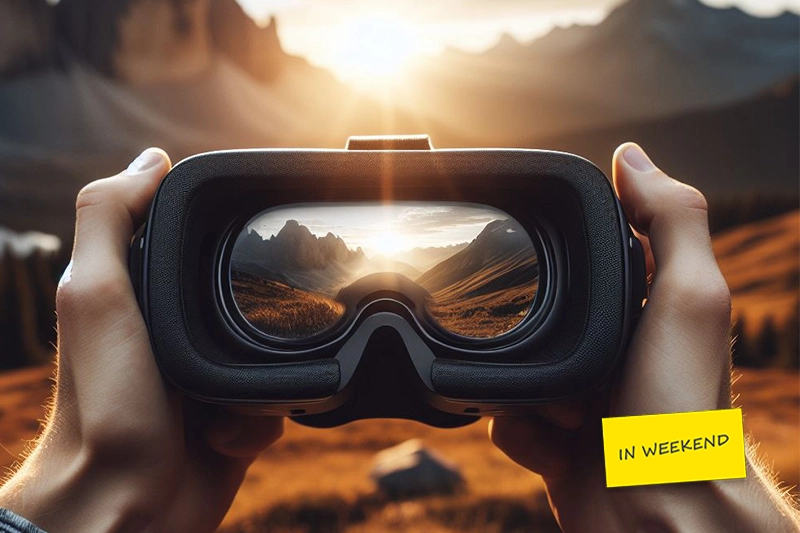
Virtual tourism powered by VR has become a true revolution. With modern VR headsets, you can instantly “teleport” to unique locations, from exotic beaches to mountain peaks. The sensation of being present, combined with realistic sounds and detailed environments, is remarkable. Virtual tourism has become a real option for those who want to explore the world from the comfort of their own homes. From virtual tours of museums and cities to even intergalactic journeys, VR promises a new era of exploration where borders become merely digital lines on a connected global map.
The integration of AI into virtual tourism can play a crucial role in creating more realistic environments. Thanks to machine learning capabilities, AI can enhance details and interactions, providing a more authentic virtual experience.
VR and AR, combined with AI, will influence how we interact with digital maps. Instead of being static representations, AI can provide dynamic information such as local events, route changes, and personalized recommendations.
Technology is shaping our future in ways that are difficult to predict. While these technologies can be extremely useful and efficient, they can also become harmful if overused, especially if people begin to lose connection with the real world.