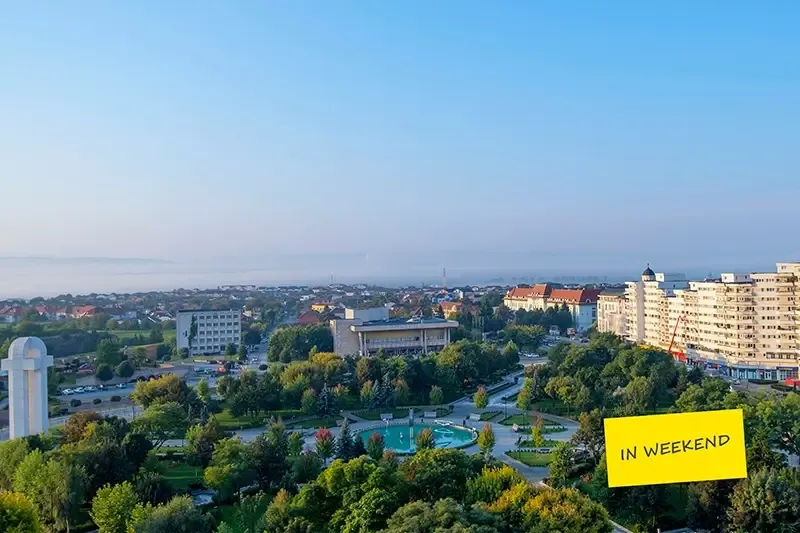
The city of Alba Iulia, also known as the “White Fortress of Iuliu” (a name derived from Old Slavonic), is located in southwestern Transylvania, on the banks of the Mureș River, and has a rich and captivating history.
Before the Roman conquest, an important Dacian fortified settlement known as Apoulon existed near the current location of the city, as mentioned on ancient maps. After the Roman victory and the conquest of Dacia by Emperor Trajan, the city was renamed Apulum, and the existing Dacian fortification was expanded by soldiers of the XIII Gemina Legion stationed in the area. During the Middle Ages, the city reappeared in documents in 1199 under the name Alba Iulia, derived from Iula, a local ruler from the 10th century. Alba Iulia later became an important administrative center within the Kingdom of Hungary in Transylvania. In medieval Slavonic documents, the city was also referred to as Bălgrad, meaning the White Fortress.
The coat of arms of Alba Iulia is rich in historical and cultural symbolism. The shield is divided into three distinct sections. In the first section, on a blue background, stands the golden eagle of Wallachia, accompanied by a sun on the right and a moon on the left. In the second section, on a red field, is the silver head of the Moldavian aurochs, flanked by a radiant sun on the right and a crescent moon on the left, with a five-pointed star between its horns. In the upper part of the shield, on a golden background, two red winged lions hold a black sword between them. At the top of the coat of arms, on an ermine background, rises the steel Crown of Romania.
These symbolic elements carry deep meanings. The crown at the top represents Romania and commemorates two key moments in national history: the country’s independence in 1877 and the Great Union of 1918.
The eagle, the aurochs head, and the winged lions are traditional symbols of the Romanian provinces—Transylvania, Moldova, and Wallachia—whose unity was achieved in 1918. The mural crown with seven crenellated towers signifies Alba Iulia’s status as a municipality and county seat, highlighting its historical importance.
For a comfortable stay in Alba Iulia, Hotel Cetate Împăratul Romanilor can be an option. With a modest three-star rating, it offers decent services and a beautiful view of the Alba Carolina Citadel.
It should be noted that the hotel has remained relatively unchanged over time in terms of renovations. Do not expect luxury or modern facilities here. However, in the morning, you can wake up and enjoy the warm sunlight illuminating the Alba Carolina Citadel. You can also enjoy a tasty breakfast on the ground floor.
Alba Carolina Citadel is the most important tourist attraction in Alba Iulia. This massive fortress was built in the 18th century and is one of the largest fortified structures in Europe. It is divided into three parts: the Lower Citadel, the Middle Citadel, and the Upper Citadel.
The Lower Citadel is where history meets the present. Here you will find the Reunification Cathedral, a masterpiece of architecture, and the National Museum of the Union, where impressive exhibits reveal the story of the country.
The Middle Citadel is a beautifully arranged area with alleys and gardens, perfect for relaxing walks. It is also home to the statue of Michael the Brave, symbolizing the unification of the three Romanian principalities.
The Upper Citadel offers a panoramic view of the city and its surroundings.
On December 1, 1918, Alba Iulia witnessed a crucial historical moment. Here, the Great National Assembly proclaimed the union of Transylvania with the Kingdom of Romania. This event marked a significant step in consolidating Romanian national identity.
Alba Carolina Citadel is not only about history and architecture. Its well-maintained gardens and pedestrian alleys make it a perfect destination for relaxing walks, whether on foot or by bicycle. The entire citadel is crossed by well-designed cycling paths that ensure smooth movement and minimize interactions between pedestrians and cyclists.
Transylvanian cuisine
Your experience in Alba Iulia would not be complete without enjoying the delights of Transylvanian cuisine. From traditional polenta to stuffed cabbage rolls and plum-based desserts, you will experience an authentic Romanian culinary journey.
Alba Iulia is an unforgettable destination for those passionate about history, architecture, and the beauty of Transylvania. To fully explore every corner of the citadel and admire the treasures of its fascinating museums, it is highly recommended to spend at least three days in this captivating city. During this time, you will have the opportunity to immerse yourself in its authentic atmosphere and discover its rich cultural heritage. Alba Iulia awaits you with open arms for a journey full of discoveries and unforgettable memories.